
‘The Cruel Sea’ survivor for real – “I’ve got yer, I’ve got yer”.
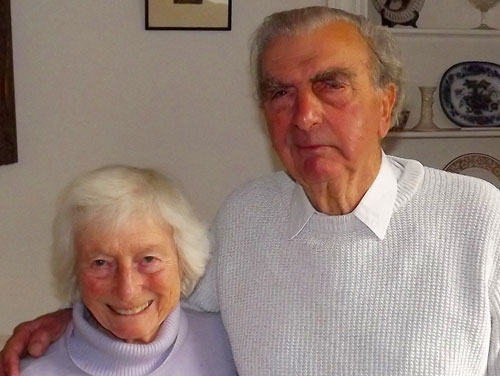
We are grateful to Bob Hind who has so generously shared this story with us and to Captain Gordon Walwyn RN Rtd, together his wife Wendy, for allowing us to reproduce their photographs. A valuable piece of film history that we are proud to record and add as background information to this film.
Bob writes:
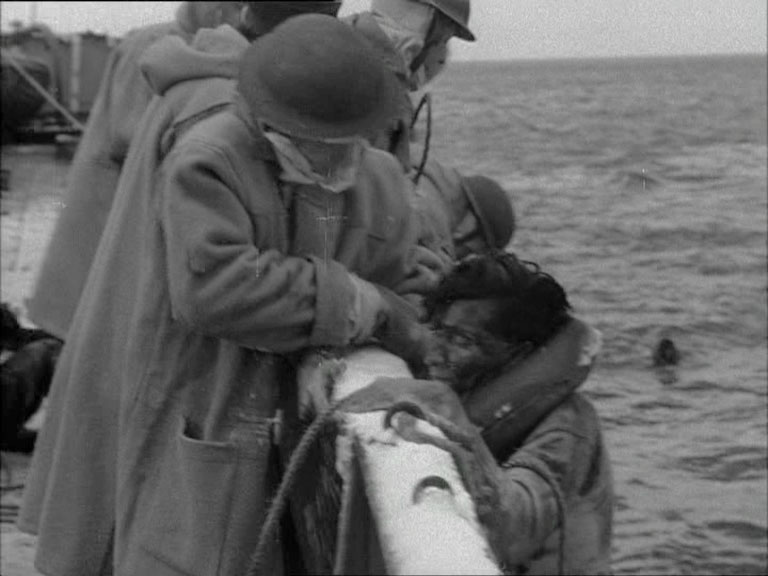
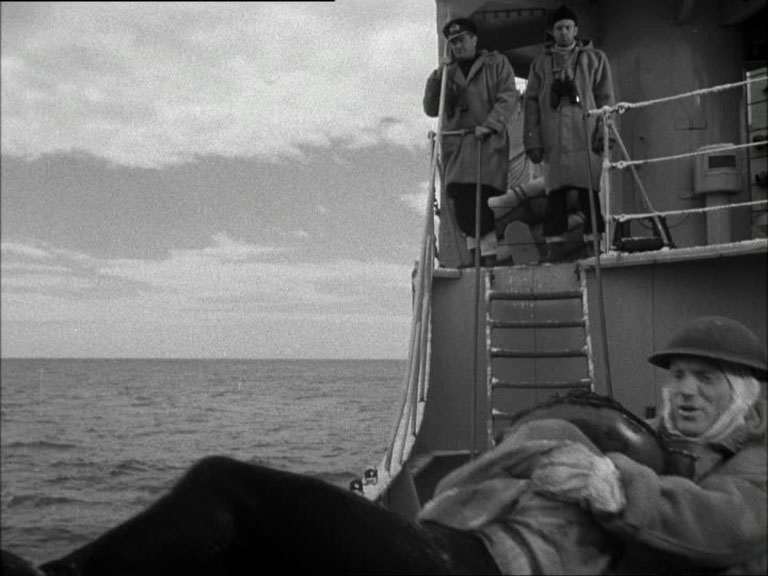
At the end of the film a German U boat is attacked and sunk by H.M.S Saltash Castle and survivors can be seen swimming in the sea below. These survivors were played by some of the crew, one of whom still survives and lives in Warblington. Gordon Walwyn, was then a midshipman and later made captain. He has allowed me to be informal and call him Gordon throughout this article. F362 H.M.S. Portchester Castle, a Castle Class frigate based at Portland, was chosen to play the part of H.M.S. Saltash Castle in the filming of Nicholas Monserrat’s book. The commander was Lieutenant Commander Howard Winnall – a New Zealander. During filming, every sailor onboard had an extra’s part rushing around the upper deck, firing guns etc.
All the filming took place south of Portland in an area where the “Portland Races ” occur. This is an area where opposing tidal streams meet and it causes the sea to be rough and very, very turbulent and that’s exactly what Ealing Studios required. Scenes were filmed of the U-boat being forced to surface and the Saltash Castle opening fire, resulting in the U-boat, played by an R.N. ‘S’ class submarine, sinking. With the British to be seen recovering the survivors, the Director Charles Frend, approached the captain and explained they needed a scene of rescuing the U-boat survivors. He could send to London for professional people to play the part at great expense, or perhaps volunteers from Portchester Castle could be the stars. Naturally, Gordon, a Lieutenant and six sailors volunteered. They then learned what they had to do. Dressed in white U-boat sweaters, covered in genuine fuel oil, they became as black as the ace of spades and were thrown into the middle of the Races. The ship would steam on about 1/2 a mile and the survivors had to swim back to it. Everyone was told to act as though their lungs were filled with fuel. Gordon said: “We were totally exhausted and we really had to act the part there was not a lot of need as we were dragged on board. We must have all been mad!” Gordon thinks he was amongst the last to be pulled on board, and he coughed and spluttered as instructed. At the order “Cut” the Director rushed down to Gordon, very concerned, and said: “Are you alright Mid?” Gordon replied, “Yes, fine.” The Director thought Gordon was so good he wanted him to do the scene again, just him, so he was thrown over the side again. A petty officer threw a heaving line and as Gordon reached the railings said “All right mate, I’ve got yer, I’ve got yer” and the net result was a few seconds at the end of the film. Gordon told me they did not actually dive off the submarine because it had by then “sunk”. Later, the Director said that the ‘survivors’ could be paid £8 each or he would pay for the whole ship to have a run ashore. The latter was chosen and the ratings had an evening on the beer in Portland while the wardroom had dinner with the full film crew at the Moonfleet Hotel at Moonfleet west of Weymouth. I must thank Massimo Moretti for use of screen shots of the film.

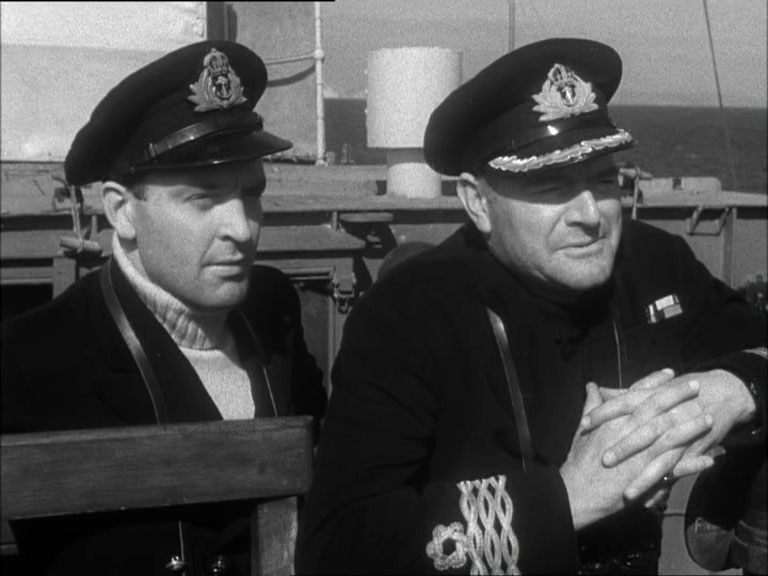
Bob Hind advises that Commander Ericson (Jack Hawkins), left, has “wavy lines”, intertwined gold braid on his sleeve because he was not a Royal Navy officer but a Mercantile Marine (Merchant Navy) officer called to the colours during wartime measures. (Courtesy Studio Canal Films Ltd)