
“Amsterdam in Pinewood” – The Set
Phil Bailey, whilst researching in preparation for uploading the film Operation Amsterdam to the Website found the following articles in Dutch newspapers.
From De Volkskrant via www.delpher.nl The original text can be read here but Frank van den Berg has very kindly provided us with the English translation
Amsterdam corner in Pinewood
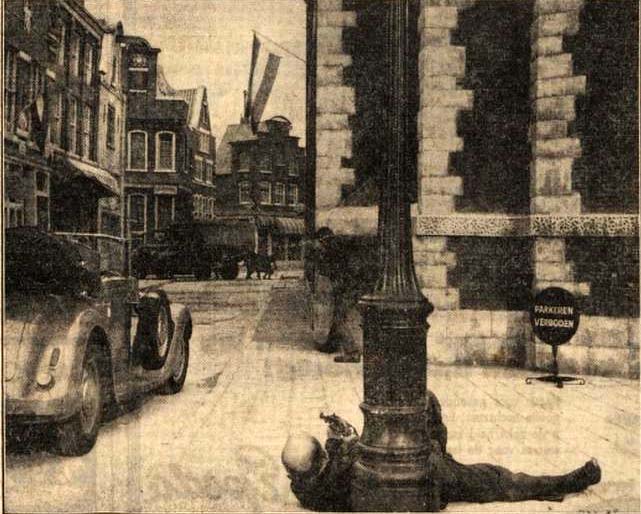
“Battle scene” in an English studio for “Operation Amsterdam”, a film that shows the panic of the days in May 1940 and tells about an adventurous story of several Dutch people who smuggle a treasure of diamonds out of the country.
In the Nieuwlandstraat bullets were flying around
(From our special reporter)
Pinewood, 10 October
In the sloping landscape of the English county Buckinghamshire they reconstructed an idyllic part of Amsterdam to an even attractive part of London. Nieuwlandstraat, Centrum became King Street, Soho. Around the corner there are three lifeboats with the fragile name “Titanic” on the bow. On the other side of a dirty pond are three palm trees, who in the depressing light of a comfortless autumn day look bored. A dramatic, dressed in black, French woman with a fascinating face walks several hundreds metres away, studying bundles of typed folios. In the long concrete building behind her is, under dozens of spotlights, a grey pre-war open car, that in the Netherlands – In any case in Amsterdam and Ijmuiden – during a holiday would have made quite an appearance. The old license plate GZ 6231 would appear to the Dutch newspaper reader as familiar as the faces of the four people inside the car: Eva Bartok, Peter Finch, Tony Britton and Alexander Knox.
This is the overall impression of Arthur Ranks enormous Pinewood studio complex. A bizarre false world where recent films about the demise of the Titanic and the battle against the Japanese were realized. Where Juliette Greco plays a modern Lorelei and where they finished “Operation Amsterdam”. This week are the last recordings of the film, about the true adventure of the daredevils who, just before the Germans reached Amsterdam, saved industrial diamonds with a value of several millions of guilders out of the safes and transported them to England. Now it is time for hard work in dark rooms, little theatres, sound studios and smoky conference halls. Only at the end December or the beginning of January the world premiere of “Operation Amsterdam” can be expected.
In the long Studio – because of it’s shape called “The Tunnel” toiled the same crew, a remarkable appearance in the environment of Amsterdam. The tall taciturn director Michael McCarthy and his perfect antitype producer Maurice Cowan, the stars, the camera specialist, the sound engineers and many many others. They are each excited about their stay in Amsterdam.
LONG LIVE THE AMSTERDAM POLICE
Eva’s praise for the Dutch and their capital city sounds a little slick and obviously meant for the publicity. The comments of the others are in all ways nice. Peter Finch has bought as a permanent memory a painting for his huge collection. “From the school of Breugel” the seller assured him. Tony Britton still wears the white tie with the red M, the sign of men’s club that was formed in an Amsterdam hotel. Alexander Knox did send yesterday some postcards to his new Dutch friends. The producer and the director are very content about the cooperation of the Dutch authorities, especially from the Amsterdam police who made their work easier. “I can see myself already at Scotland Yard coming with the question if they can close down Regent Street for a day” says McCarthy. The helpfulness of the Amsterdam law enforcement didn’t had any boundaries. But even they had to say “No” when we wanted to create a massive gunfight in the middle of the city. That is why we recreated a piece of Amsterdam here. The masterpiece did cost over ten thousand guilders. A crew of 250 architects, carpenters, painters, scaffolding builders, electricians and others did work here day and night for more than ten days.
A COUPLE OF MINUTES WORK
The whole job took intensive research. Billboards had to match with the market as it was in 1939. Inscriptions and text on stores and warehouses in the streets couldn’t have the new spelling. No detail could be ignored because the filming had to fit in ten thousands of meters film that were actually shot in the Dutch capital city. Two days long the cameras were rolling and shooting in the English Amsterdam. The caution of the Dutch police was certainly justified. Before the director was satisfied ten thousands gunshots from machineguns and revolvers were shot with blanks in the Nieuwlandstraat, Buckinghamshire. The half of them from fast driving cars, all for only a few minutes on the white screen. And no one from Pinewood saw anything special in it. A permanent staff of thousands of specialists – from hairdressers to brilliant engineers – work daily in the fifty departments of the studio to produce films around the ever changing stars on the 8745 square meter indoor studios and the 270,000 square meters outside.
The Austrian actor Ernst Valder has the nicest souvenir from the Rank adventure in Amsterdam: a neatly framed collection Dutch coins. Valder made the frame himself. The money was put next to him by a classy Amsterdammer with a generous gesture when he – dressed in rags and temporarily decked out with a unsanitary beard – was waiting in an alley with his back to the wall waiting for the next recording. A compliment to the make-up artist – even though the Netherlands are not used to an invasion of international film circus with support and fringe.
From De Telegraaf via www.delpher.nl The original text can be read here. Translation by Google Translation.
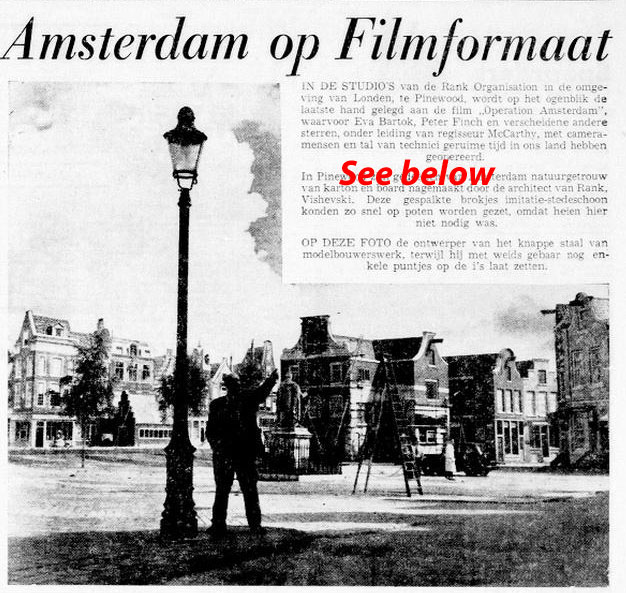
Amsterdam on Film Format
IN THE STUDIOS of the Rank Organisation near London, at Pinewood, the film “Operation Amsterdam” is currently being finalised, for which Eva Bartok, Peter Finch and several other stars, directed by Michael McCarthy, with cameramen and numerous technicians have operated in our country for quite some time. In Pinewood, parts of Amsterdam have been faithfully recreated from cardboard and board by the architect of Rank, Vishevski. These splinted chunks of imitation urban beauty could be set up so quickly. IN THIS PHOTO the designer of the handsome set of modelling work, adds a few finishing touches with a grand gesture.
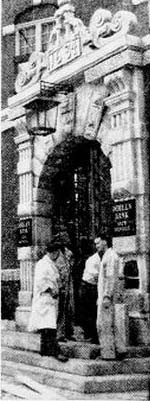
BANK SECRET
Reproduction of an Amsterdam bank building, where it can be clearly seen that it is counterfeit, because behind the door there is scaffolding to save the bank from a “crash”.
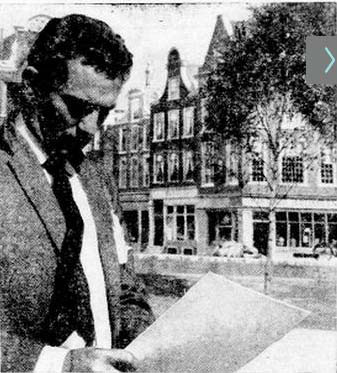
CARDBOARD INSPIRATION
Protagonist Peter Finch makes a drawing of the above cardboard square. Drawing and painting are his hobbies
From De Telegraaf via www.delpher.nl The original text can be read here. Translation by Google Translation.
Phil points out that this article whilst showing various pictures from the shooting of Operation Amsterdam also has some from The Diary of Anne Frank that was shooting at the same time. In addition there are some interior shots from a pottery works on Duivendrechtse Kade which seem to match the scenes where Tony Britton’s character meets the resistance group.
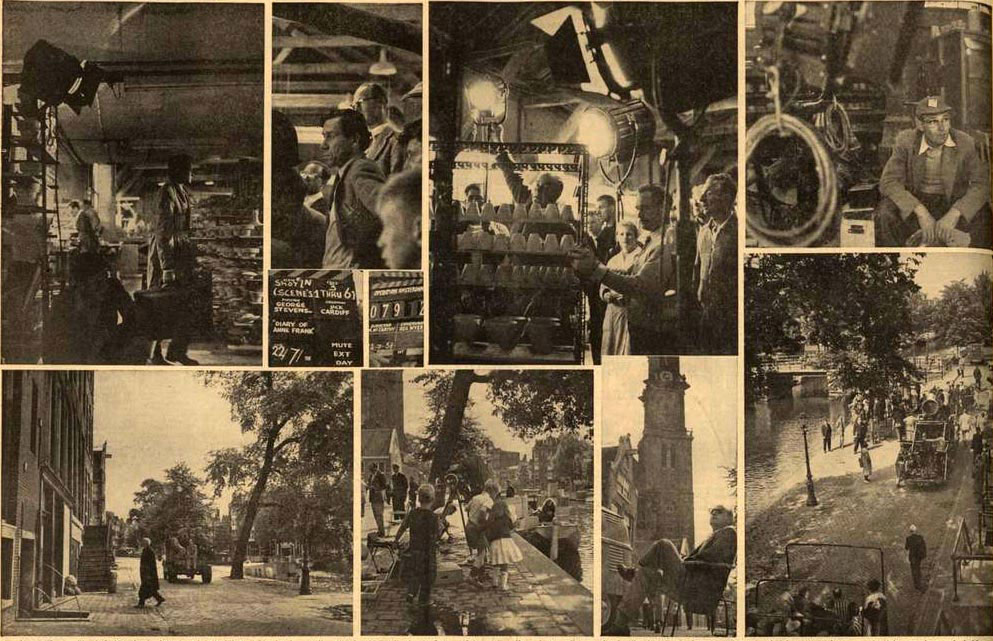
AMSTERDAM – FILM CITY
Amsterdam – film city. It does not have to be taken too literally, there are still streets without cameras. But sometimes there is suddenly one, an English or an American, because two film groups are in these weeks in the capital of the country, recording feature films in which, in time, we have our own piece of canal, our own tower and perhaps even our own face. The English are here the longest. Their film is called Operation Amsterdam, and that says enough. Yesterday they did their work in a pottery on the Duivendrechtse Kade: the actor Britton walked there with a suitcase, director MacCarthy had a heavy head behind the camera, lighting experts arranged the spotlights, and the “officials” of the team have sought peace for a moment in the strangest places.
For the Americans who are making the film Anne Frank’s Diary, Amsterdam means the end of the work: on the Prinsengracht they have shot their outdoor recordings in recent days, to which they, in order to get as close as possible to reality, chose the Anne Frank House as the “real” setting. There, a “stand-in” for the American actor who plays Anne’s father made the scene of the homecoming from the concentration camp, there too, children from the neighbourhood, as long as the police did not sweep the streets clean, could be carefree around the expensive equipment; there was an enormous amount of sitting by dignitaries with their own chairs – and after all, there was actually some shooting there. The people of Amsterdam as film townsmen have watched it for many hours. Photos: Maria Austria