Jimmy Snow – In the Background

Jimmy Snow (1905 – 1975) is not a name that hits a films headlines, indeed, can often remain as uncredited, despite the fact that his work could be an important part of what we are seeing during a film. Jimmy worked at both Pinewood and Denham Studios creating special effects and models. Jimmy was brought to our attention by his granddaughter Brigitte, initially, with regard to the film Encore and a screen capture on our Site. Brigitte had already had correspondence with Peter Cook via his Matte Shot Blog spot (Listed in our Links page but also can be accessed here: http://nzpetesmatteshot.blogspot.com/2014/04/) Peter has very kindly agreed to share with us such pictures as we might require and very much appreciate his association and co-operation. This is well worthy of a read in itself and there are snippets of information regarding Jimmy that are not mentioned here. Thankfully for us, Brigitte has been keen to share the many photographs of studio situations that she has in order that Jimmy’s skills can be appreciated by a wider audience and hopefully, cared for in the longer term. Films with associated photographs are highlighted in red and are clickable.
Brigitte has assembled her own biography and memories of her Grandfather and Special Effects Film Technician.
Jimmy was born in London in 1905. He was a quietly spoken and unassuming man, seldom credited for the behind the scenes work he did over a period of 40 years and often letting others take the credit. This lack of credit was just the way it was years ago and he was just one of many in that situation.
He started work in the Film Industry as a Chippy [Carpenter] at Denham Studios in the 1930s. In 1940, what was the GPO Film Unit became the Crown Film Unit [CFU] within the Ministry of Information and Jimmy worked at the CFU all during the War, making models for training films, including those for the RAF.
One of the films made by the CFU was Target for Tonight (1941) which stared RAF service men and women rather than actors. Available on YouTube.
Jimmy’s daughter remembers the film crew used to have to consult with service personnel and a man from the Navy, who was advising on submarines, lodged with Jimmy and his wife for a while. Tragically, he then returned to the War and was killed.
After the War, and right up until the 1970s, he worked mainly at Pinewood studios, but was occasionally seconded to do jobs for other studios. He also did some work with Les Bowie, for example, on Dracula Has Risen From The Grave (1968), uncredited.
One of the first films produced at Pinewood after the War was Black Narcissus (1947) for which he built a model of the Convent. However, by 1949 he had expanded his skills to include setting fire to things:
From The Londonderry Sentinel of 9th August 1952 under the title: Warm Welcome.
“Whenever I see Jimmy Snow coming my way I know that I’m in for a hot time says John Mills on the set of The Long Memory (1953) at Pinewood Studios. I first met Jimmy at Denham, during the making of The History of Mr Polly (1949) when he had the pleasant task of setting light to my trousers for a scene in the film. Now he has just done it again for a fire sequence in The Long Memory. I’m not a vicious type really, chipped in Jimmy, who is now Section Head of Stage Effects at Pinewood Studios but it’s a strange coincidence that on the only two occasions I have had to set fire to a star it has been John Mills! More spectacular – if less personally hazardous – film fires with which Jimmy Snow has been associated during his twelve years as a ‘fire bug’ include: Blanche Fury (1948), Highly Dangerous (1950), High Treason (1951), Encore (1951) and The Planter’s Wife aka Outpost in Malaya (1952) . I’m quite prepared to believe that Jimmy wouldn’t consciously hurt a fly but it’s a little nerve-wracking to have a fellow constantly around fired with such burning ambition cracked John with a grin”.
In the 1950s he built a model of the Hotel for Hotel Sahara (1951) and was also involved in moving models such as the vehicles seen driving across the desert in the film. These vehicles apparently ran on tracks. He made model motorised lifeboats for A Night to Remember (1958) which involved, for the actual filming, him along with a lot of other crew members all getting into the Pinewood tank wearing waders.
The 1950s also saw the making of An Alligator Named Daisy (1955) and rather than model building or pyrotechnics Jimmy had the job of arranging the foam around Diana Dors in the bath. Proving how varied his work was!
Mostly, Jimmy worked at the Studios but he did go on location for the Malta Story (1953) and to Tripoli for The Black Tent (1956) and to Amsterdam for Operation Amsterdam (1959).
A nephew remembers a Rolls Royce arriving at the house to take Jimmy to Heathrow Airport to go to Africa. The nephew and Jimmy’s wife went with him in the car which also contained Anton Diffring, who, apparently, was a nice man and nothing like the character he played in The Black Tent (1956)!
At Pinewood, around the time of Golden Salamander (1950), Hell Drivers (1957) and Campbell’s Kingdom (1957), he worked with Charles Staffel. Other colleagues were Frank George, Bert Luxford and Bert Marshall – Bill Warrington, who I believe was the head of the section, was the one person usually credited for the Special Effects on the films they all worked on. However, Jimmy was credited on film for The Battle Of The River Plate (1956) and The Seekers aka Land of Fury (1954).
Bert Luxford, who worked with Jimmy, makes several references to him in his book: “The Gimmick Man”. He states that he and Jimmy “worked on all manner of bits and pieces … anything and everything from fires to stuffing straw up people’s backs”. I can only guess which film the straw was for, but perhaps Dr. Syn, Alias The Scarecrow?
Later on, during the time of the early Bond films he worked with John Stears who was then the head of department and therefore credited with the Special Effects. Bert Luxford’s book refers to the three of them; Bert, John and Jimmy all working on the model, and subsequent blowing up, of Dr No’s Bauxite mine.
Jimmy’s name is now mentioned on numerous Bond fan websites in relation to him designing and making the revolving number plates on James Bond’s Aston Martin. He also designed and built the ejector seat for Goldfinger (1964).
He worked on the first six Bond films and several of the Carry On’s. As children were always told that he made Barbara Windsor’s bra fly off in Carry On Camping (1969) by use of a fishing line. However, this now seems unclear as Bert Luxford refers to the scene in his book and states that several different methods were tried. Barabara Windsor in her memoirs said she was pulled flat on her back in the mud by an “elderly prop man” who was hidden in the bushes behind! It may have been the fishing line failed and they used some other method.
Two film appearances of Jimmy at work behind the scenes are in “The Making Of A Night To Remember” where he can be seen organising the model lifeboats in the water and “A Child’s Guide To Blowing Up a Motor Car” where he is wiring up and loading explosives into the back of a car for a scene in Thunderball (1965).
Besides the known associated photographs there are some of which the connected film remains a mystery…..can you help?
A listing of the films in which Jimmy was associated, compiled by Brigitte, can be read here.
Memories:
Growing up knowing that Grandad worked “at the Studios” [Pinewood], did not seem unusual or special at the time. Now, I am amazed to know how many films he worked on and how much he achieved. Of course, now we wish we still had all the bits and pieces he brought home from the studios for us to play with: a trombone from the Norman Wisdom film, A Stitch In Time (1963) and a guitar signed by Tommy Steel. There were some small metal Spitfire planes which I guessed were from the Battle of Britain (1969) but another relative says he was given model planes that were used in Malta Story (1953) so could have been either. There was a foam rubber monster head with glass eyes, I have never been able to find which film this was from, and some stuffed hummingbirds. There were also a lot of films scripts which presumably would have just been thrown away. They were only printed on one side so made good scribble paper for us kids.
The Golden Salamander has been with us for as long as we can remember. It was in the front garden when we were growing up and is with us still. Also, a plaster head used in Carry On Loving (1970) where there is a shot that blows a hole in the head – done of course with a small explosive placed inside and triggered at the right moment.
Jimmy’s daughter remembers another technique to make it look like bullets were hitting a wall – there was a string fixed onto the wall, behind the wallpaper, presumably with something attached at intervals which when pulled off made holes in the wall as the machine gun “fired”.
Another job he did was to attach an inner tube to Mary Poppin’s dress – looking at the film I presume this would have been to make the skirt stand out when she was up in the air.
He made some monsters for one of the Quatermass films.
The work required constantly coming up with ideas and inventions. He had three patents for: An Improved Method and Means for Creating an Artificial Fog, Mist or Smoke; An Improved Bulletless and Cartridgeless Firearm for Use in Theatres, Studios and the Like and An Improved Means for Creating Rain Effects Adapted for Cinematographic Studios.
Jimmy’s daughter vividly remembers an early smoke machine which used burning oil – the smell was terrible and Jimmy tried to disguise this by adding perfume to the mix.
A colleague remembered Jimmy teaching him how to use a monster of a smoke machine called a Bessler. Another popular effect for smoke and fog was dry ice. Jimmy’s daughter remembers him having some at home with which he froze some grapes which they then bounced down the hallway. Bonfire night was a major event where they lived and all the local kids would come to see their firework display. Jimmy managed to obtain all sorts of big bangs including something called a “Thunder Flash” which shook all the surrounding houses.
His firearm invention was mentioned in Kinematograph Weekly of 1946 when a photograph was captioned “Denham effects men Sid Yorkie and Jimmy Snow make Bren-gun effects for Top Secret”. For the purposes of the record and clarity it is worth recording here that the original title Top Secret was changed to School for Secrets and when the film was released it went under the title Secret Flight (1946).
I remember a visit to Pinewood Studios at the time they were filming Chitty Chitty Bang Bang (1968), I was about 12 years old and seeing not only the car but the filming of a scene. We stood at the back of the small studio, the red recording light was on so we had to be quiet. It was a musical number with Lionel Jeffries singing and at the end the wheels fell off the car.
I also clearly remember a landscape scene painted on a piece of glass, which would have been done so that they could “superimpose” the car to look like it was flying. This I am sure would have been done by Cliff Culley.
When we went to visit our Grandparents as kids Jimmy always had a stash of “flash paper” in the sideboard which we always persuaded him to get out. Lit by a match or cigarette lighter, a piece would burn with a large flame and very quickly disappear into thin air before it fell down onto Grandma’s carpet. He always used to say “turn the juice [electric] off first” before doing anything as he had suffered numerous electric shocks.
As I was quite young at the time the only things I remember him saying about the Bond films was how uncomfortable Sean Connery was during the filming of the laser scene in Goldfinger and that George Lazenby walked onto a bedroom set and said he wasn’t happy with it and it all had to be changed.
A nephew of Jimmy’s used to visit him at work at Pinewood, just a teenager at the time, he cycled there on his pushbike and actually helped in the filming of a scene by getting him to move a paddle in the water tank containing the model to create the effect of waves while he blew smoke across and the cameraman filmed. So different to today when you can’t just walk into Pinewood Studios let alone get involved in what’s going on!
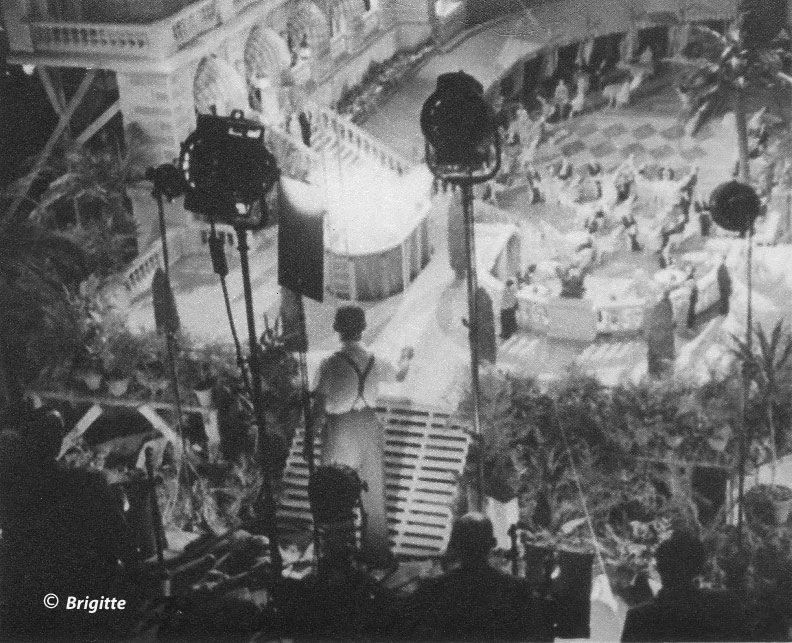
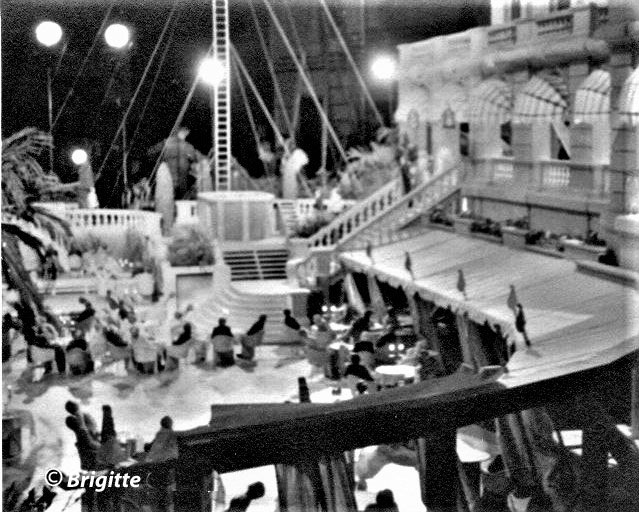
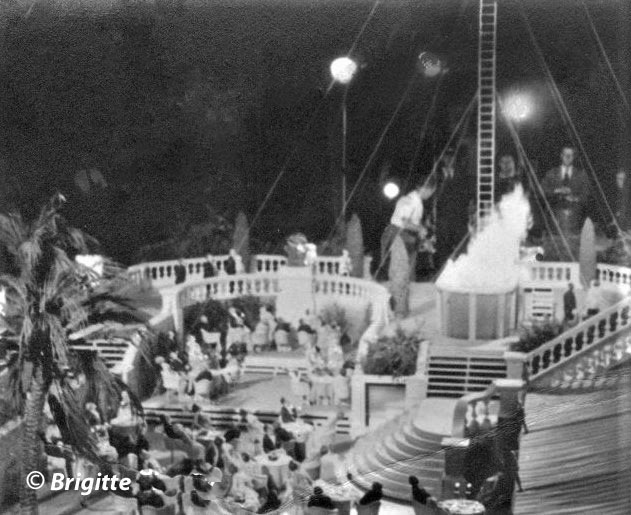
It is perhaps appropriate that we conclude Brigitte’s Bio and Memories with the ‘behind the scenes’ pictures that started our association with her and prompted all that we can now enjoy and savour.
Encore (1951) – Our Capture 17 has never received a comparative shot nor did we have it marked as a studio set, so where did this model fit in? A closer, slower, look at the film is required!